
The API key was in the chat: what the Fireworks breach says about where credentials travel now
On November 11 Notion revoked a set of its own API keys. It had found them inside transcripts of Notion AI conversations that had been exposed in a breach at Fireworks AI, a vendor Notion used to run part of its AI workload. The next day it reported other vendors' keys, found in the same transcripts, to the vendors that had issued them.
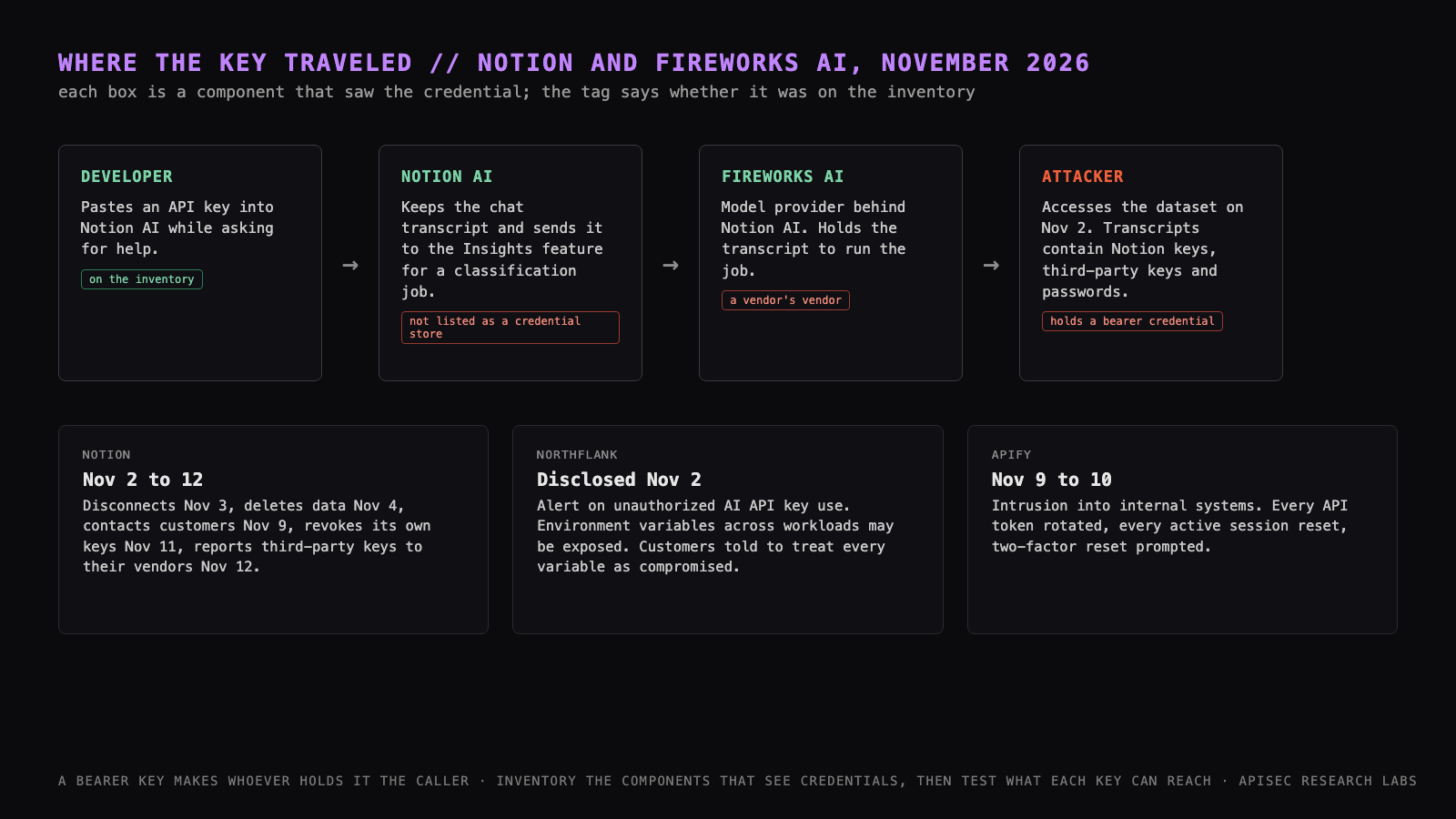
Figure 1. The path the credential took from a developer to an attacker, and which of the components on that path were on the inventory, with the Northflank and Apify incidents from the same fortnight.
What happened
Notion's advisory gives the timeline. On the evening of November 2, Fireworks told Notion that an unauthorized party had accessed a dataset, which at that point was believed to hold synthetic test data only. Notion disconnected from Fireworks the next morning and deleted its data from Fireworks' systems the day after. On November 6 Fireworks reported that customer data might have been reached. On November 8 it confirmed the affected dataset, and on November 9 Notion contacted the customers involved, under one percent of its workspaces.
The exposed data was transcripts of Notion AI chats used by the Insights feature. Most were not labeled with a user or a workspace, and they did not include tool call results. They did include whatever people had typed into the assistant, and some people had typed passwords, credentials and API keys. Notion revoked the Notion keys it found on November 11, reported the third-party keys on November 12, disabled the Insights feature, stopped serving open-weight models through Fireworks, and asked affected customers to rotate anything they had pasted into the assistant during the incident window.
In the same two weeks, two developer platforms reported incidents of their own. Northflank, a deployment platform, disclosed on November 2 that environment variables across customer workloads may have been exposed after an alert about unauthorized use of AI API keys; it told customers to treat every environment variable as compromised. Apify, a web automation platform, rotated API tokens for affected customers and reset every active session after an intrusion on November 9 and 10, and said it found no indication that customer account data on the platform was compromised. Wiz has been tracking a run of attacks on AI developer platforms through October, in which stolen keys are used to consume paid model services at the victim's expense.
What these have in common
In each case the thing taken was a credential, and in each case the credential was sitting somewhere its owner had not counted as a place credentials live.
A Notion AI transcript is a conversation. The person who pasted an API key into it was asking for help, not storing a secret, and the transcript then traveled to a vendor's vendor as part of a classification job. An environment variable on a deployment platform is configuration; the platform holds it so that the application can run, and the application's owner has no reason to list the platform as a credential store. A session on an automation platform is a convenience.
Every one of those is a component that an application now talks to, and every one of them saw a credential. The inventory most security teams keep lists the APIs the application exposes and the libraries it imports. It does not list the AI assistant that developers paste into, the model provider behind the assistant, the deployment platform's secret store, or the automation service holding a token. Those components have joined the application's attack surface without joining its inventory.
Why this is important now for an API security program
An API key is a bearer credential. Whoever holds it is the caller, and the API on the other end cannot tell the difference between the developer who created the key and the person who read it out of a transcript. So the question after each of these incidents is the same: what can this key reach, and what would an attacker do with it at runtime?
That question has two halves, and a program needs both.
The first half is inventory. Which components see credentials, and which credentials do they see? For an AI assistant, the answer is anything a user typed. For a model provider, the answer is anything the assistant forwarded. For a deployment platform, the answer is every environment variable. A team that cannot list those components cannot rotate the right keys after a breach, which is why Notion's advisory reads as a list of discoveries made during the investigation rather than before it.
The second half is proof. A leaked key is a finding, and the severity of that finding depends on what the key is allowed to do against the running API. A key scoped to read one resource is a nuisance. A key that reaches another tenant's data, or an administrative endpoint, is a breach waiting for someone to use it. The way to know which one you hold is to call the API with it and record what comes back, which is the same test an attacker runs, and the same test that confirms the key is dead after rotation.
What to do this week
Rotate anything that has been pasted into an AI assistant, and say so to the people who use one, because the assistant's vendor has vendors of its own.
Add the AI assistant, the model provider, the deployment platform and any automation service to the inventory, as components that see credentials. Our free tool ai-surface reads what an application's agents are built to trust and lists those components from the code; it is a start on the first half.
Test what each key can reach. Scope keys to the least that the caller needs, and confirm the scope by exercising the API with the key rather than by reading the policy that is supposed to apply.
The pattern in these three incidents is not new attackers or new exploits. It is credentials moving through more components than anyone had written down, and the fix is to write them down and then prove what each one can do.
Sources: Notion security advisory, "Security incident involving a third-party AI vendor" (timeline, data exposed, keys revoked and reported, customer guidance); eSecurity Planet on the Notion response; Cybersecurity News on the Northflank disclosure (October 30 alert, November 2 disclosure, environment variables, LLMjacking, Wiz's October reporting); BleepingComputer on Apify.