
7 posts tagged with "Cross-Industry"

Cross-Industry

View All Tags

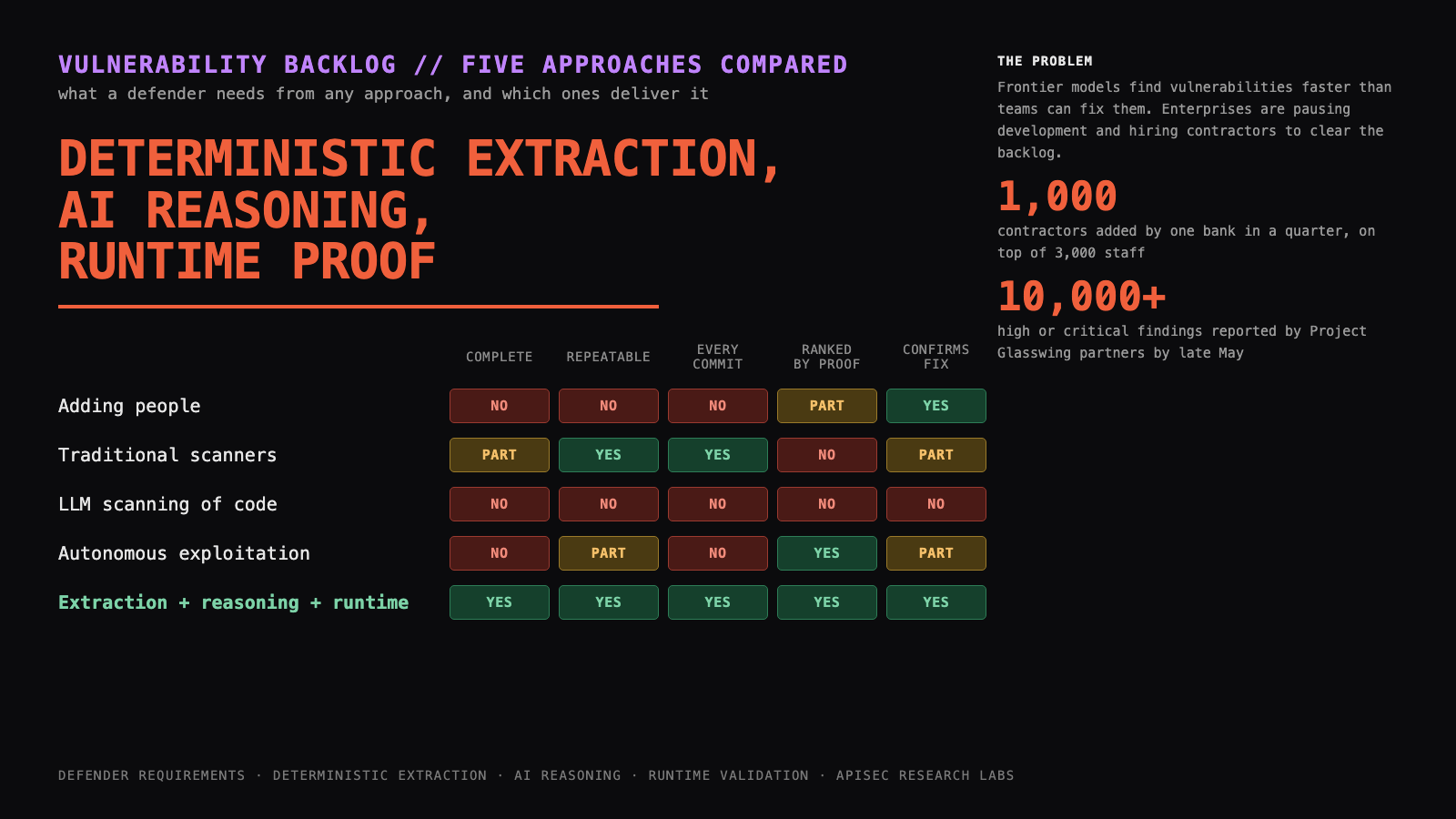
Enterprises are pausing development to fix vulnerabilities. A comparison of the approaches on the table.
· 13 min read
Rajaram Ramanathan
APIsec Research Labs

In April 2026 Anthropic released Claude Mythos Preview to a closed group of companies and government agencies under Project Glasswing, a coalition that includes AWS, Apple, Cisco, CrowdStrike, Google, JPMorganChase, Microsoft, NVIDIA and Palo Alto Networks. The model finds software vulnerabilities on its own and at scale. By late May the partners had reported more than 10,000 high or critical vulnerabilities in widely used software, and a review of a sample of those findings by Anthropic and six independent security firms confirmed more than 90 percent of them as real. Anthropic has kept the model restricted and has described the ease of finding vulnerabilities, compared with the difficulty of fixing them, as the main challenge now facing cybersecurity.
ZOOMSDAY: What Happens When Exploits Outrun Patches?

· 5 min read
Bandana Kaur
APISec Research Labs

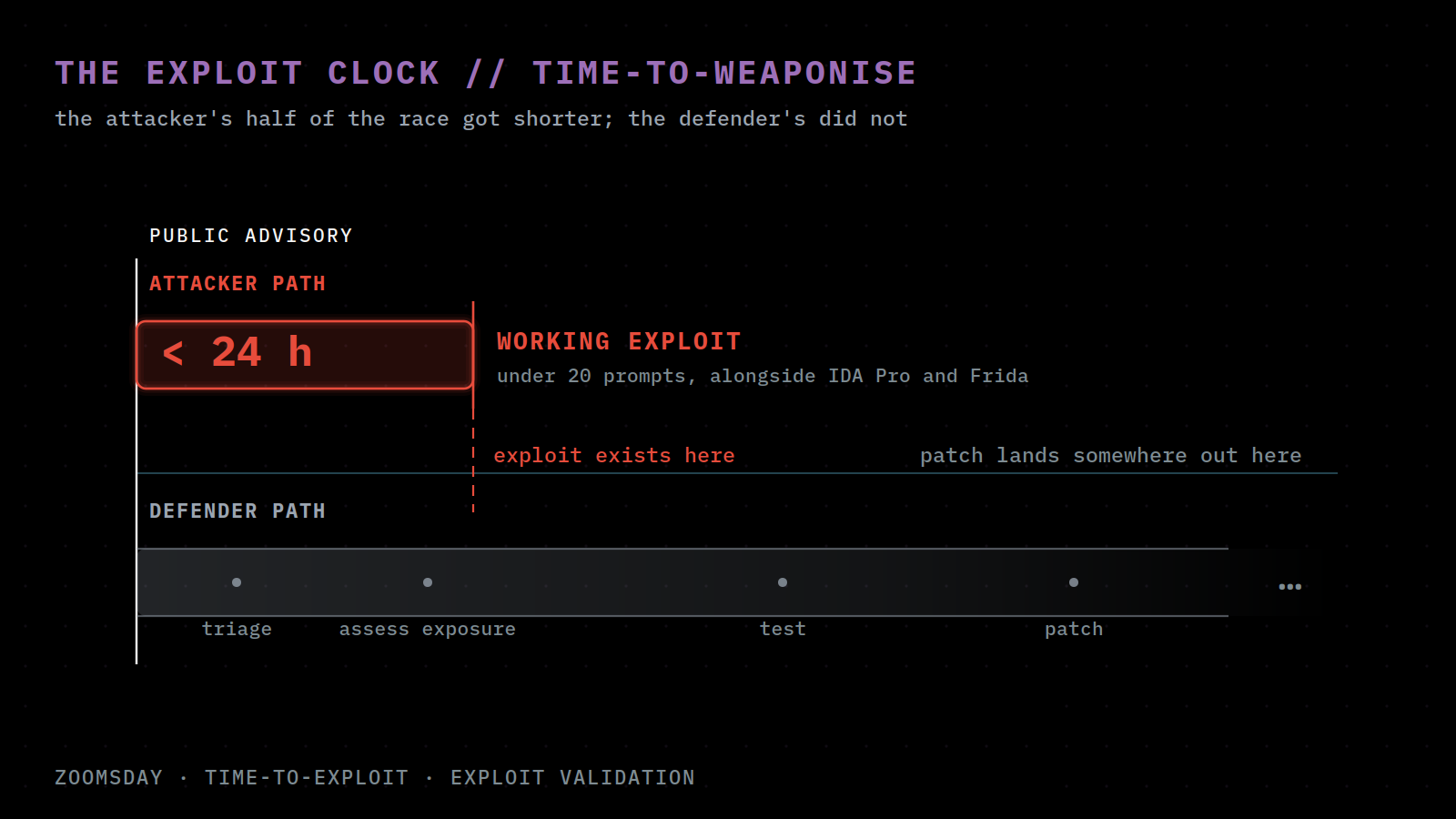
A vulnerability as severe as remote code execution can go from public advisory to working exploit much faster than most orgs can go from triage to patch. AI compresses the amount of time and expertise required for vulnerability research, but defenders are increasingly playing a game where the attacker gets the first (and faster) move. How do we level the playing field?

The Seven Wonders of OAuth Exploitation

· 14 min read
Bandana Kaur
APISec Research Labs

Sign in with Google, the signature verifies, and the token is valid. PKCE checks out, the redirect_uri matched exactly, state came back untouched. Textbook flow, start to finish. Then the application runs find_user_by_email(claims.email), and the session goes to whoever controls that address.

Ten of the OAuth and OIDC vulnerability reports we read end that way. In none of them did the protocol fail. It ran perfectly and handed over the account anyway.

The Proxy Problem: Applying Goodhart's Law to AI-Generated Vulnerability Reports

· 10 min read
Bandana Kaur
APISec Research Labs

Over the past year, bug bounty platforms have reported a dramatic rise in AI-assisted, "slop" vulnerability submissions. Much of the discussion has centered on whether large language models are capable of discovering genuine vulnerabilities or whether they merely generate convincing-looking but ultimately meaningless reports.

Beyond the $175K Bankrbot Hack: Encoding Attacks Across Layers of the Agentic AI Stack

· 10 min read
Bandana Kaur
APISec Research Labs

The assumption baked into most agentic systems is simple: safety lives at the model layer, so that's where you defend. But model and tool layers don't share a threat model, and attackers who know that can walk straight through the gap. The Grok Bankrbot incident made it visceral. Morse-coded prompt injection. $175,000 moved in seconds. The community called it a model-layer problem and moved on. They were half right. In security, what does the other half cost you?

What 100+ BOLA Reports Taught Us About Where Object-Level Authorization Actually Fails

· 8 min read
Bandana Kaur
APISec Research Labs

Your API has a bouncer. Very professional. Checks every ID at the door. Unfortunately, once you're inside, you can walk into the kitchen, rearrange everything, and delete someone else's reservation and he's still at the front door, extremely proud of himself.

Most security teams know what BOLA is. Broken Object Level Authorization, the vulnerability where an API doesn't verify that you're allowed to access the specific object you're referencing, not just the endpoint. It has sat at the top of the OWASP API Security Top 10 since 2019. There are guides, courses, and CTF challenges built around it.

And yet we analyzed over 100 validated, publicly disclosed bug bounty reports from HackerOne spanning 2021 to 2026, across 29 organizations including GitHub, GitLab, Shopify, Mozilla, and more, and found something that should give every security team pause.

The way most teams are testing for BOLA doesn't match how BOLA actually shows up in the wild. Here's what the data says.

First, a Quick Note on the Tag Noise​

One number worth flagging: roughly 39% of reports tagged IDOR or Improper Access Control on HackerOne don't describe BOLA under rigorous criteria. Wrong vulnerability class entirely, auth bypass without object reference, business logic on a user's own resources. If your team is using platform tag-counts to estimate BOLA exposure, you're likely overstating the signal significantly. Hence, these were excluded under the prefilter criteria of our research.

Finally, the 84 confirmed, in-scope reports are what everything below is drawn from. The full dataset, classification methodology, and analysis scripts are available on GitHub.

Prompt In, Shell Out: Exploiting GitHub AI Toolchains

· 7 min read
Bandana Kaur
APISec Research Labs

A developer sits down, opens their AI assistant, and asks a completely normal question:

“What are the open issues in my repo?”

Thirty seconds later, their SSH private key is on an attacker's server.

They never clicked a link.

They never ran a script.

They never left their IDE.

In our security research, we identified a command injection flaw in a GitHub MCP server which could enable remote code execution (RCE) on a developer's machine, with no user interaction beyond asking about open issues.